
Should you sell your Edmond home or keep your low mortgage rate? It comes down to three numbers: your current rate and balance, what your home is worth today, and what the next home would cost at today's rates. Mark Osterman is a REALTOR® in Edmond, Oklahoma helping homeowners and buyers decide with real numbers, and I worked in mortgage lending before I ever sold a house.
Here is how those three numbers work together.
What is the lock-in effect?
The lock-in effect is what happens when homeowners who want to move stay put, because their current mortgage rate is so much better than today's. They are doing the math, and the math is hard to argue with.
CNBC's Investing Club put it simply on October 6, 2026. You may be able to sell at a higher price, but do you want to trade a sub-3% rate for 7%? Going from 3% to 7% on a 30-year fixed loan raises your principal and interest payment by about 58% a month.
Here is what that looks like on a $500,000 loan. At 3%, principal and interest is about $2,108. At 7%, it is about $3,327. That is roughly $1,218 more every month for the same loan amount. That example is my own math, not CNBC's.
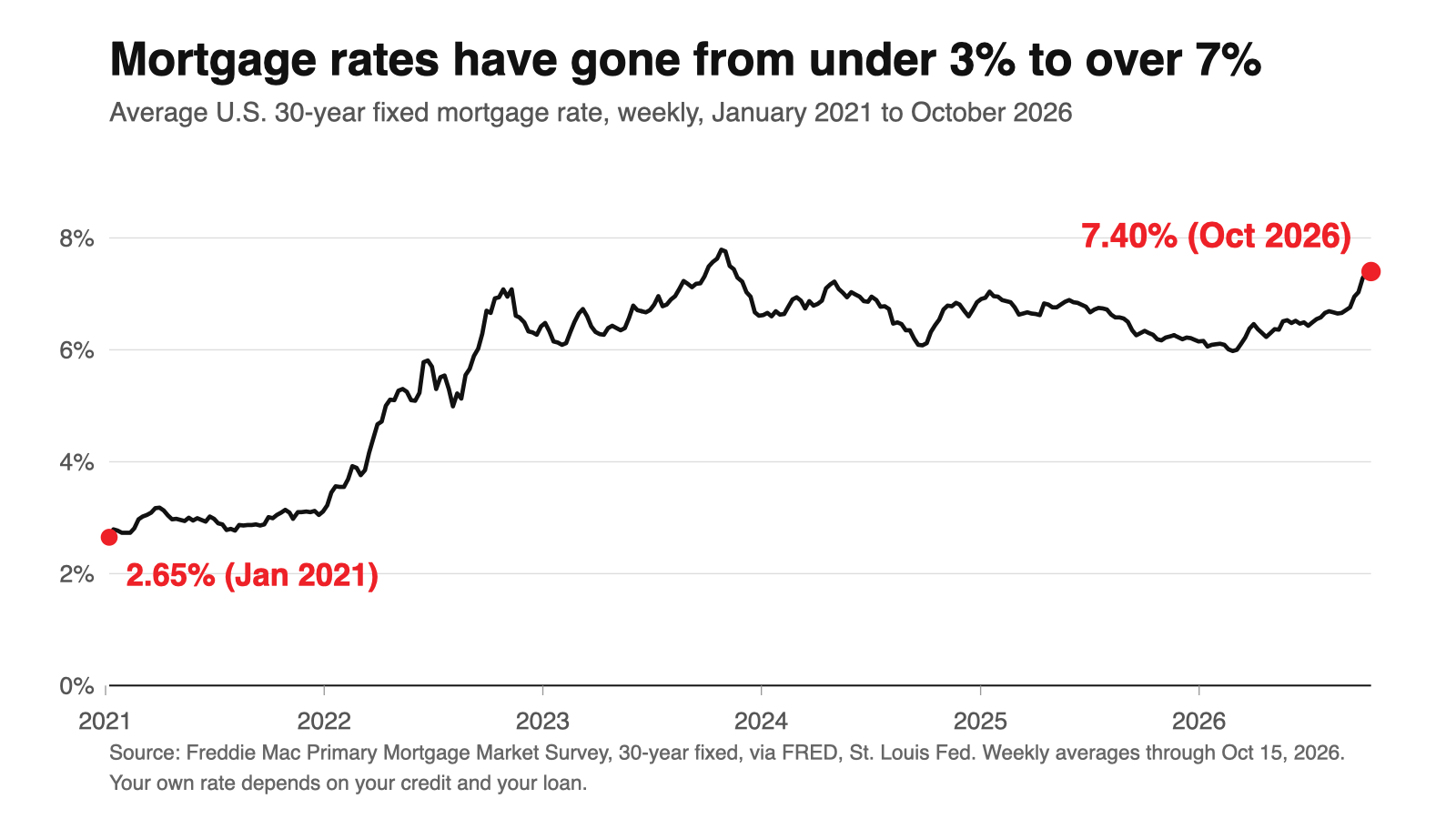
Freddie Mac's weekly survey shows how far rates moved. The average 30-year fixed rate was 2.65% in early January 2021. It peaked at 7.79% in October 2023, and it was 7.40% in the survey dated October 15, 2026. Your own rate depends on your credit and your loan.
How much more does a move cost?
CNBC's Diana Olick reported in April 2024, using ICE Mortgage Technology data, that the average homeowner with a near record-low rate would see their payment jump about 132%, roughly $1,800 a month, to move into a home 25% more expensive. Buying the same house they already own would raise the payment about 60%.
Those are 2024 national averages, and rates and prices have moved since then. The shape of the problem has not changed. A move is a payment decision first and a house decision second.
Is a 7% mortgage rate actually high?
It feels high after 2021. The longer view tells a different story.
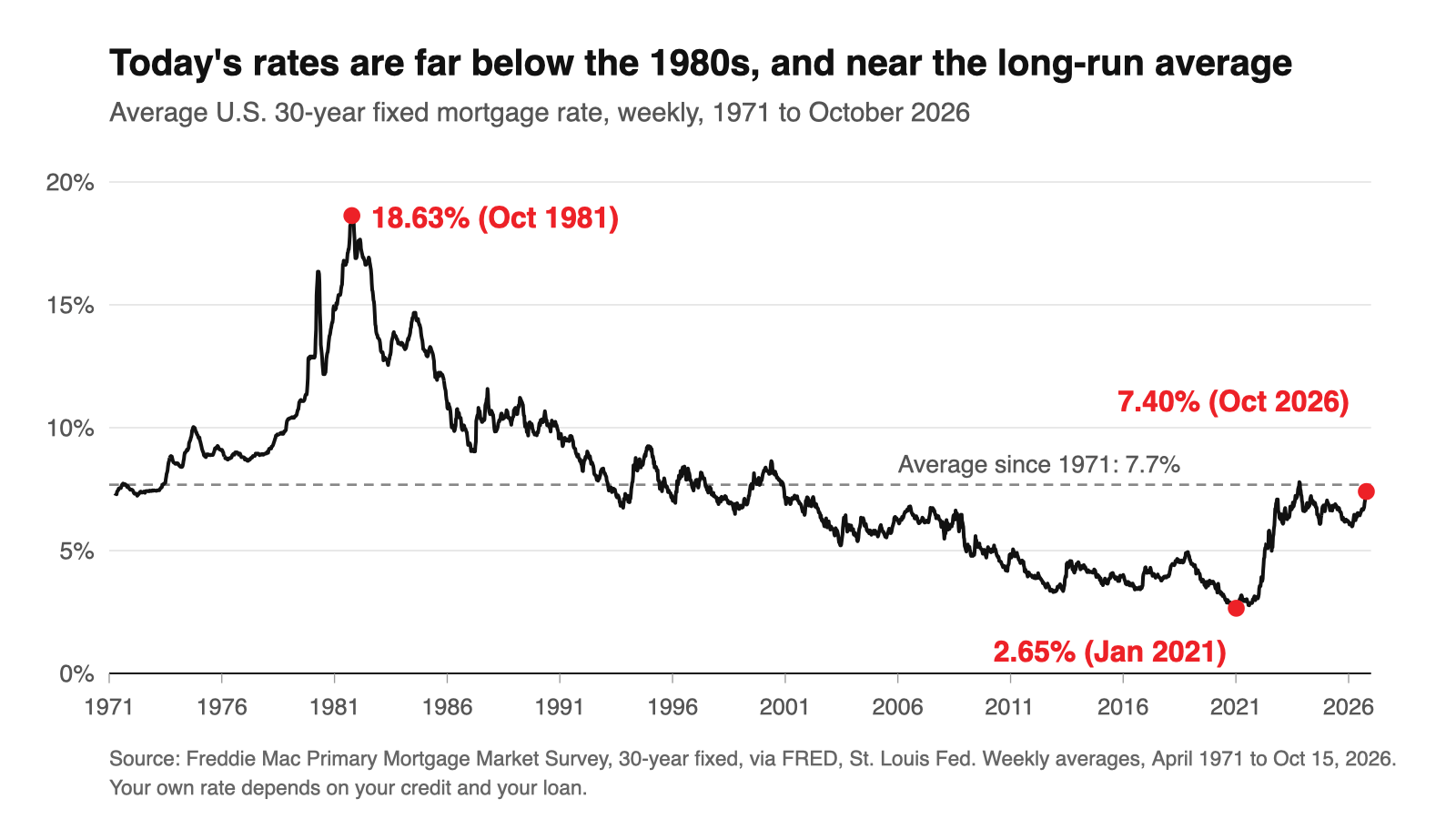
In October 1981, the average 30-year rate hit 18.63%. Through the 1980s it averaged about 12.7%. Today's 7.40% is far below that.
It is also close to the long-run average, which is about 7.7% since 1971. So today's rate is not unusually high, and it is not a bargain either. What was unusual was 2021, when rates dropped to 2.65%. A lot of homeowners are holding a rate that history says was the exception.
Are more homeowners starting to sell?
Slowly, yes. Melius Research, quoted by CNBC on October 6, says about 50% of homeowners now have a mortgage under 4%, down from 61% three years ago. About 22% now have a rate of 6% or higher, up from 10% three years ago.
More people are carrying a rate closer to today's market, which makes a move less painful. Melius expects that trend to continue for at least the next two to three years and to bring more existing homes to market. For buyers, that is worth watching.
What about my equity?
The payment is only half of the picture. Home values have climbed a lot since 2021.
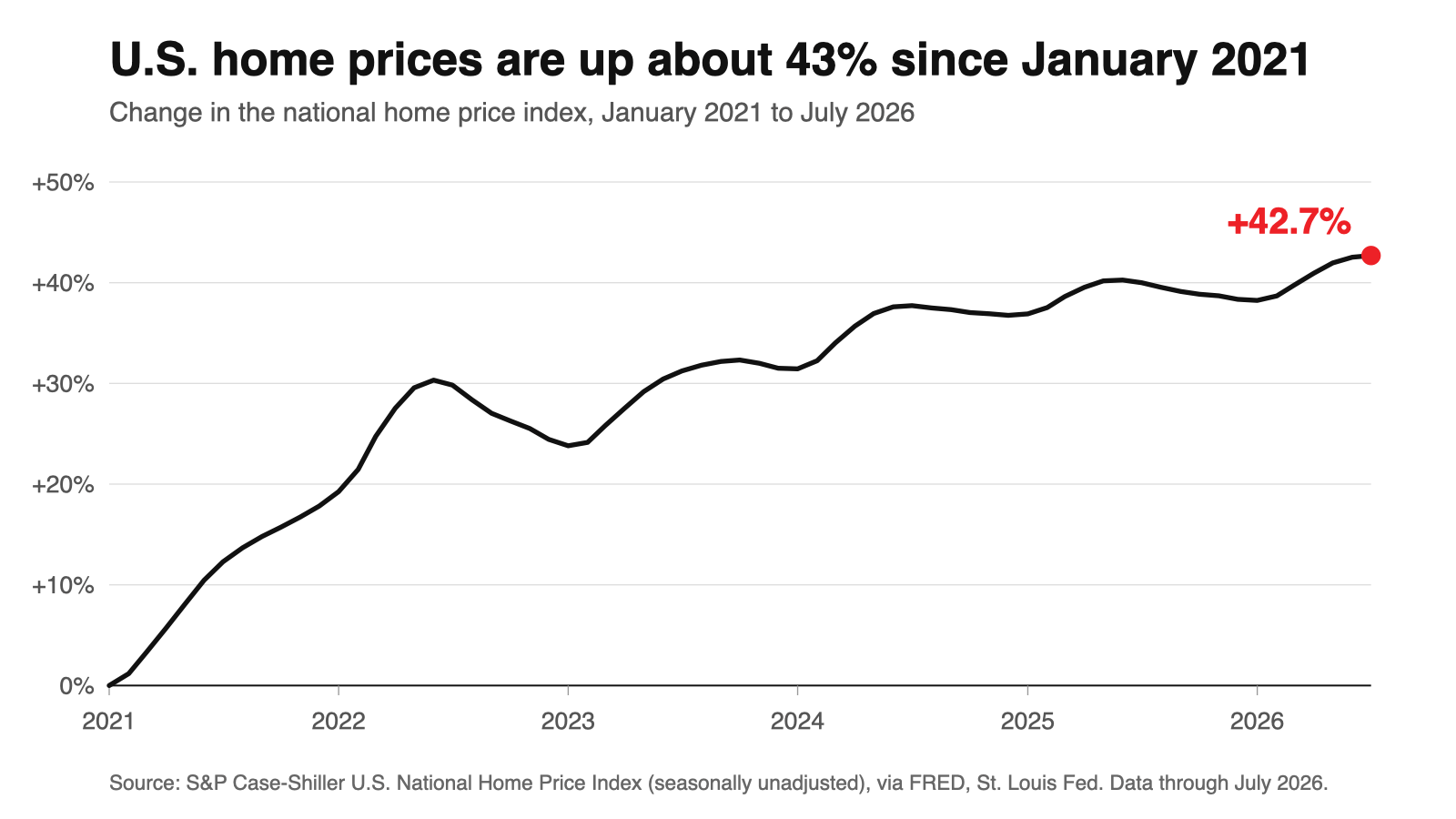
According to the S&P Case-Shiller national index, U.S. home prices are up about 43% from January 2021 to July 2026. A home worth $500,000 in January 2021 would be worth roughly $714,000 at that national pace. That is my own math, and it is a national figure. Edmond neighborhoods will differ, and so will your home.
If you have owned since 2021, you likely have far more equity than you did when you bought. After the costs of selling, that equity can go toward your next down payment and soften the sting of a higher rate. Most people only look at the rate.
What are my options if I am locked in?
You have more choices than "sell" or "stay." There are three.

Photo: Max Vakhtbovych, Pexels.
Sell and take the new rate. This makes sense when the next house solves a real problem and the new payment fits your budget. Run the numbers first so there are no surprises.
Keep the house and rent it out. This is what Kelli and I did. We have a home with a lower interest rate, and we did not want to give that up, so we did not sell it. We became landlords and rented it out. Keeping the low rate means our rental earns a better return than it would with a loan at today's rates. It is not for everyone. A rental means repairs, tenants and a second set of responsibilities.
List it and let your rate go with the house. This is the one most sellers forget. Some loans are assumable, which means a qualified buyer can take over your existing mortgage, rate included. FHA and VA loans are generally assumable. Most conventional loans are not. If your loan is assumable, say so when you list. Buyers are looking at rates in the 7s, and a lower rate on the table may earn your home a second look. It is not a guarantee, and not every buyer can use it. If you want to talk through whether your loan can be assumed, I can recommend a lender to walk you through it. You're free to use any lender you like.
What should a buyer know about assumable loans?
If you are buying, an assumable loan can be a way into a lower rate, but it takes planning. Three things to know.
The seller's loan servicer has to approve you, the same way a lender would approve a new loan. You will usually need to cover the gap between the seller's loan balance and the sale price, either with cash or with a second loan. And the loan still has to fit your budget, no matter how good the rate looks. Ask the seller's agent early whether a listing's loan is assumable, then bring that to a lender. If you want to talk it through, I can recommend a lender who can explain how an assumable loan works for your situation. You're free to use any lender you like.
How do I decide, step by step?
- Find out what kind of loan you have and what your rate is. Ask your servicer whether the loan can be assumed.
- Get a rough number for what your home would sell for and what you would net after costs.
- Ask a lender what the next home would cost per month at today's rates.
- Put the options side by side: sell, rent, or list with an assumable loan. Compare the full monthly payment, not just the rate.
- Decide based on how the house fits how you live, not on the rate alone.
What mistakes do people make?
Many homeowners wait for a perfect rate. Nobody knows when rates will fall, and a house that no longer fits costs you every month you stay.
Others compare only the rate and forget the equity they have built. Some never check whether their loan is assumable, so they never find out they could offer it. And some assume a rental is simple, then find out how much work it is.
What does this look like in a real example?
Take a homeowner with a $500,000 balance at 3%. Their principal and interest is about $2,108. If they sold and bought a similar-size loan at 7%, it would be about $3,327, roughly $1,218 more a month. But if they bought in January 2021 at $500,000, their home may be worth around $714,000 at the national pace. That is about $214,000 of added value, before selling costs, that could go toward the next home.
That is an illustration of the math, not a specific client. Your numbers will be different, which is why they matter.
Frequently asked questions
Can I keep my low rate if I move? Your rate belongs to the loan on your current house, so it does not move with you. You can keep that house as a rental and keep the loan, or sell to a buyer who assumes it if your loan allows.
Are all mortgages assumable? No. FHA and VA loans are generally assumable. Most conventional loans are not. The loan servicer has to approve the buyer either way.
Will a buyer pay more for a house with an assumable loan? Not necessarily. A lower rate can make a house more attractive to some buyers, but the price still follows the market, and the buyer still has to cover the gap and qualify.
Is now a good time to sell my Edmond home? That depends on your three numbers. Home values nationally are up about 43% since January 2021, and rates sit near their long-run average. I can pull current numbers for your neighborhood so you can see where you stand.
Do I need a lender before I talk to you? No. Start with the numbers. When you are ready to talk financing, I can connect you with one of the lenders we work with. You're free to use any lender you like.
Want to see your own numbers?
Mark Osterman is a REALTOR® in Edmond, Oklahoma helping homeowners and buyers decide with real numbers. Call the team at (405) 593-TEAM (8326), or call me directly at (405) 818-9670 or Kelli at (405) 808-1082, and we will run your options side by side with your current loan.
Keep reading: See what your home is worth | Explore Oklahoma City area communities | Search homes | More articles from The Osterman Team
Sources: CNBC Investing Club, "A new analyst call on Home Depot reflects our feeling on what to do with the stock," Oct. 6, 2026, citing Melius Research. CNBC, Diana Olick, "Here's what upgrading to a nicer home could cost you, and why it's locking up the market," Apr. 2, 2024, citing ICE Mortgage Technology. Freddie Mac Primary Mortgage Market Survey and S&P Case-Shiller U.S. National Home Price Index, via FRED, Federal Reserve Bank of St. Louis. Photo: Max Vakhtbovych, Pexels.
Mark Osterman, REALTOR®, The Agency Oklahoma. Oklahoma Real Estate Commission license #173758. Rates and figures change. Talk to a lender and a tax or financial professional about your own situation. Equal Housing Opportunity.
